
Hardware · TMUX30-SS

Thermistor Multiplexer

Up to 30 thermistors or other resistance-based probes on one solid-state board — read all of them over Modbus TCP, or send any one of them to an analog output selected by five 24 V control lines.

Thirty probes, one board

Temperature monitoring across a cold storage or controlled-atmosphere facility can mean hundreds of probes. The TMUX30-SS brings up to 30 of them onto a single board with solid-state switching — no mechanical relays to wear out — and a 24-bit converter for precise readings.

It’s designed for thermistors, with custom Steinhart-Hart coefficients for whatever probes you use, and it reads other resistance-based sensors as well.
TMUX30-SS board installed in a panel, with labeled thermistor wiring on green terminals, two Ethernet cables, an OLED display, and blue control-line terminals
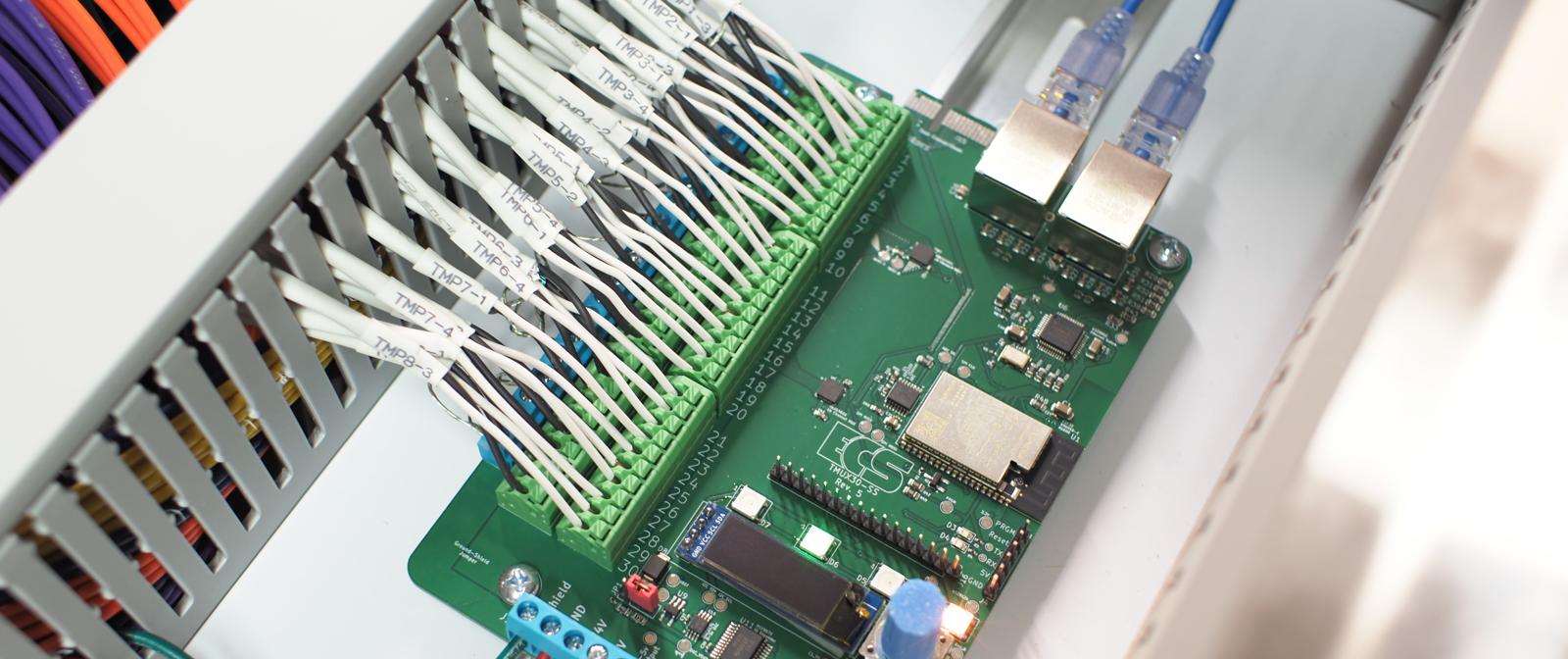
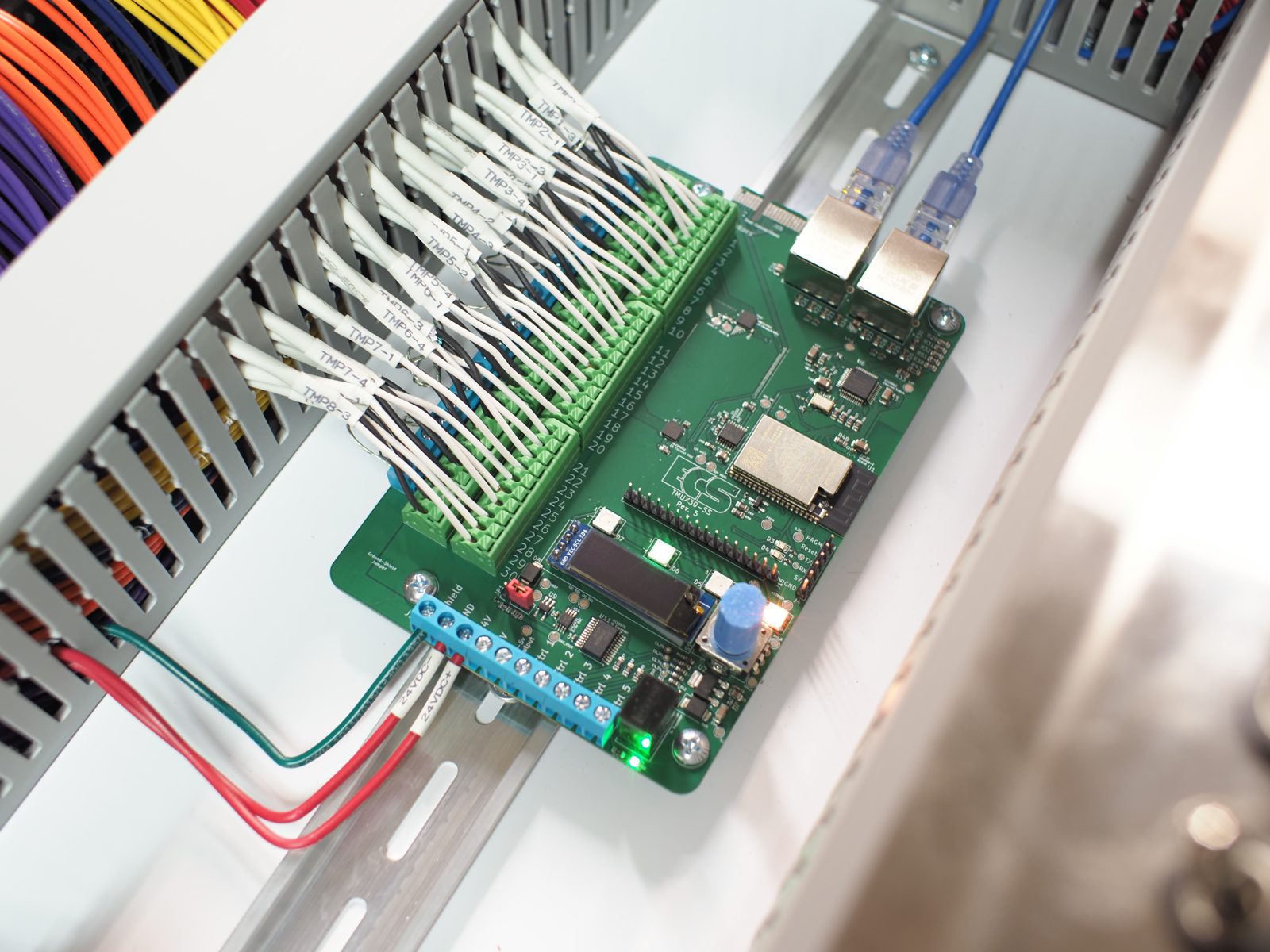
A TMUX30-SS installed in a panel — labeled thermistor pairs on the left, Ethernet at the top, and power and control lines on the blue terminals.
How it connects

Modbus TCP, analog output, or both.

The same board fits a brand-new network-based system or an existing one that reads probes through an analog input.

Modbus TCP

The board continuously sweeps every probe and serves the results over standard Modbus TCP on port 502 — resistance, °C, and °F for each channel, plus board temperature and supply voltage. It works with any standard Modbus TCP master, not just ours.

Per-channel calibration offsets and manual override values can be written from the control system, and a built-in two-port Ethernet switch lets boards daisy-chain without extra network hardware.

Analog output with control-line select

Five 24 V control lines select a probe by binary address, and the board puts that probe’s temperature on its analog output, scaled across a selectable range. Output is 0–5 V, or 0–100 mV with a jumper.

The 0–100 mV range suits existing analog input hardware such as Optomux, so the TMUX30-SS can add probe capacity to an older system without replacing it.

Built for the people who maintain it

  • Local OLED display and rotary knob — set the IP address (DHCP or static) right at the board
  • Built-in web interface for settings, diagnostics, and firmware updates
  • Service Wi-Fi access point that can be switched on when no wired network is handy
  • RGB status LEDs show processor heartbeat, network, and fault status at a glance
  • Automatic zero calibration of the measurement circuit at every startup
  • Shield terminal bus for shielded probe cable runs
  • Onboard reference resistors for checking the measurement circuit
  • Runs on standard 24 VDC panel power
How it compares

Precision where your product lives.

Cold storage and controlled-atmosphere rooms are held within a degree or two of setpoint, so the sensor and the circuit that reads it matter. Over Modbus, the TMUX30-SS reports every probe to 0.01 °C, and our own testing puts its measurement accuracy close to that.

TMUX30-SS thermistors

Thermistors change resistance far more per degree than other common sensors — roughly ten times as much as a platinum RTD — which makes them ideal for the narrow temperature band of refrigerated storage. The TMUX30-SS measures each probe against a precision resistor on the board, so the reading doesn’t depend on how steady the power supply is, and it re-zeros its measurement circuit at every startup.

Thermistors on a power-supply reference

Some systems also use thermistors but measure them against an ordinary DIN-rail power supply as the voltage reference. A power supply isn’t built to be a measurement reference: its output shifts with temperature and load, and every probe reading shifts with it.

ICTD probes

Many older Optomux systems we replace use Opto 22 ICTD probes. In our experience they drift by several degrees over time — enough to matter when rooms are held close to setpoint — and they have to be checked and offset again and again.

RTDs and thermocouples

RTDs and thermocouples cover very wide temperature ranges, which is why they’re common in process and high-temperature work. But that range comes at a cost: across the temperatures our customers care about, they produce a much smaller signal per degree and offer far less resolution than a thermistor.

Overall system accuracy also depends on the tolerance of the probes themselves. Per-channel calibration offsets let each probe be trimmed against a reference thermometer.

Who makes it

Designed by Environmental Control Solutions. Installed by Empire.

The TMUX30-SS is designed and manufactured by Environmental Control Solutions. Empire Control Systems sells and installs it as part of our control systems and retrofits.

More probes, less wiring.

Whether you’re building a new system or extending an old one, let’s talk about where the TMUX30-SS fits.